
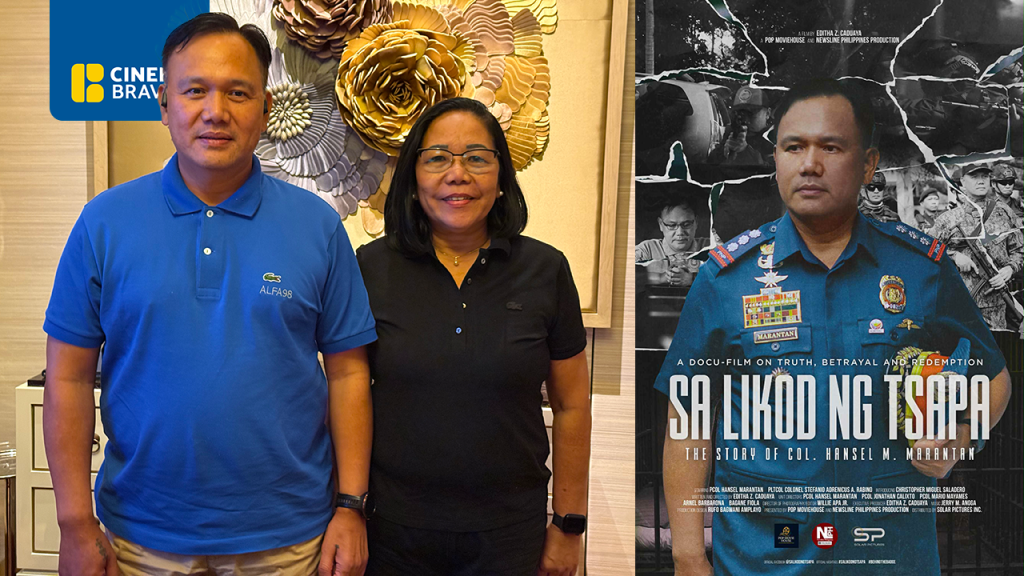
Big-name actors like Ian Veneracion, Aljur Abrenica, and Paulo Avelino were once considered to portray Police Colonel Hansel Marantan in a full-length film. But what was originally envisioned as a dramatic movie has now taken a more sobering, grounded form—as a docudrama titled Sa Likod ng Tsapa: The Story of Col. Hansel Marantan, a film by Editha Caduaya, which is set to open in Philippine theaters on August 13, 2025.
In an exclusive conversation with select members of the entertainment media including CinemaBravo, Col. Marantan revealed that the film’s journey began years ago—with multiple stalled attempts to bring his controversial life story to the screen.
“There were attempts, marami nang attempts even when I was in jail” (There were many attempts even when I was still in jail), he said, recalling his time behind bars. “Nakakausap ko na yang sina… Sen. Bong Revilla, sina Sen. Jinggoy” (I had already been speaking to Sen. Bong Revilla and Sen. Jinggoy), referring to early discussions during his four-and-a-half-year imprisonment.
But those early efforts didn’t come to fruition. “Everything is an attempt. Everything became a risk, it never came true.”
Momentum picked up again in 2017, when Marantan was granted bail. He met industry veterans Don Remo and Rez Cortez, and a second round of development began—this time with a real shot at making a movie.
“Nakapagsulat sila ng script. I was interviewed many times. Even yung mga writer nila, they came in” (They were able to write a script. I was interviewed many times, and even their writers came in), he said.
To truly bring the character of Col. Marantan to life, the team had ambitious casting ideas. “They were planning to hire professionals like Ian Veneracion, Aljur [Abrenica], and Paulo Avelino—’yan yung mga kino-consider nila” (Those were the actors they were considering).
“In fact, I think, nakausap na nila yung iba doon, to come up with a movie—movie na talaga” (I think they had already talked to some of them for a real movie). The production team even prepared a full PowerPoint presentation to pitch the project.
Plans were made to spend a month in a secluded resort, allowing the team to extract more personal stories and observe Marantan’s demeanor up close. But just when the project was gaining traction, a series of high-profile assignments derailed the process.
Among them was the controversial Teves case, in which Marantan played a key role in serving search warrants. “So, nawawala yung momentum” (So the momentum would always get lost), he said.
When things started to pick up again, another assignment arrived—this time, involving the arrest of Quiboloy. “Pinadala ako kay Quiboloy para makatulong sa pag-aresto sa kanya. I stayed there for two months na trabaho” (I was sent to help with the arrest of Quiboloy and stayed there for two months working on it). By then, the film project had lost steam once again.
Despite these detours, the story finally found its form—through the lens of documentary filmmaking. Rather than dramatizing events through actors, Sa Likod ng Tsapa takes a deeper dive into real interviews, first-hand accounts, and reenactments, blending truth and perspective in a hard-hitting docudrama.
Sa Likod ng Tsapa explores the painful cost of honor and service in a flawed system. “Isang tsapa—simbolo ng dangal at paninilbihan. Ngunit sa likod nito, may kwento ng sakit, pagtataksil, at katahimikang humihiyaw ng hustisya” (A badge—symbol of honor and service. But behind it lies a story of pain, betrayal, and a silence that screams for justice).
What began as a high-profile casting dream has evolved into something more intimate and powerful—an unfiltered look at one man’s rise, fall, and quiet fight for redemption.
Sa Likod ng Tsapa: The Story of Col. Hansel Marantan opens August 13 in cinemas nationwide. This is not just a documentary. It’s a confrontation with truth—one the audience must witness for themselves.








 CinemaBravo
Leave a Reply