
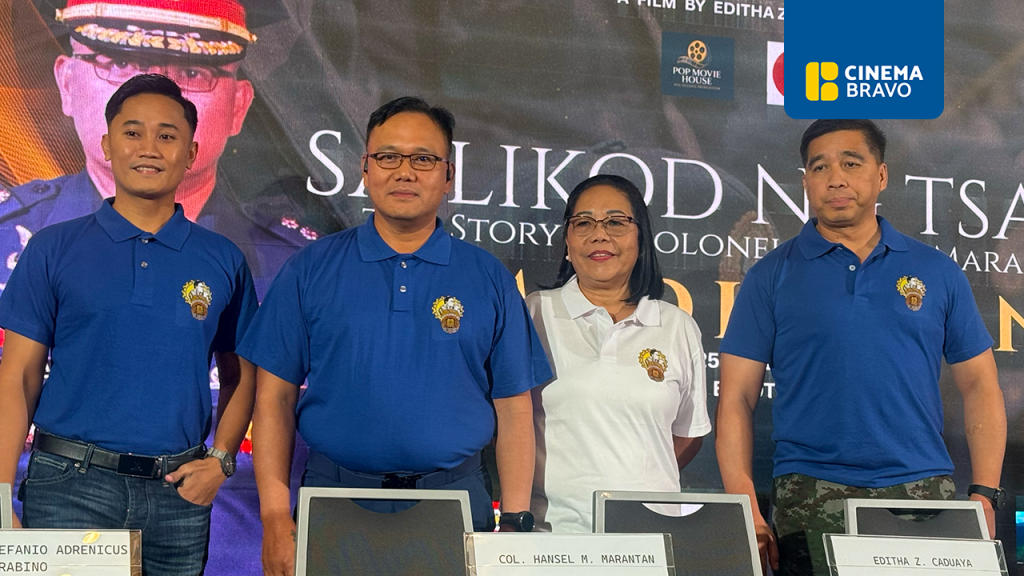
“Feeling na nilalait ako? It’s not a good feeling.”
This was the emotional admission of Police Colonel Hansel Marantan when asked by CinemaBravo during the media conference for Sa Likod ng Tsapa about how it feels to be constantly vilified in the public eye.
The former Davao City police chief and controversial figure from the 2013 Atimonan shooting incident is now at the center of a documentary film that seeks to tell his side of the story—one long buried under headlines and public opinion.
Responding to CinemaBravo during the launch held at a hotel in Quezon City on Tuesday, July 22, Marantan identified several major incidents that were included in the film—moments that defined his controversial career.
“May anim na controversial na incidents doon: like the Valle Verde, the Parañaque shootout… and a series of bank robberies dito sa Metro Manila that time. Nailabas ako doon, kasi medyo marami yung body counts doon, about 17, about 27 body count, equipped with assault rifles, high-power firearms, supposed to be owned by the law enforcers or the security forces, but now it’s being used by the perpetrators, ng Kuratong Baleleng,” he said.
(There were six controversial incidents shown there: like the Valle Verde case, the Parañaque shootout… and a series of bank robberies in Metro Manila during that time. I was included there because there were a lot of casualties—around 17, around 27—equipped with assault rifles, high-powered firearms that were supposedly owned by law enforcers or security forces, but were being used by perpetrators from Kuratong Baleleng.)
“I think you know that, you can relate with that. So, and there we stopped.
“I was asked by the Palace na to come up with the case operation. Nasa YouTube pa rin yung… Teves, Quiboloy, yung I was put to incarceration.”
(I was asked by the Palace to come up with the case operation. It’s still on YouTube… Teves, Quiboloy, the time I was put in incarceration.)
He emphasized that many other events were left out.
“Marami pang hindi nailagay, kasi I belong to a task force. Pag task force naman, you’re not there to apprehend snatchers. You are there to apprehend big catch. Kaya nagtataka sila bakit si Marantan laging involved sa armed encounter. I belong to a task force. So ang target namin ay big fish, and they are armed.
(A lot of things weren’t included, because I belong to a task force. When you’re part of a task force, you’re not there to apprehend snatchers. You’re there to apprehend big targets. That’s why people wonder why I’m always involved in armed encounters. I belong to a task force. So our targets were big fish, and they are armed.)
“So, naturally, larger percentage, there will be armed encounter.”
A fight for redemption
Marantan was direct and emotion when CinemaBravo asked how it felt to constantly face criticism and be vilified.
“Well, there’s redemption already,” he shared. “Kasi the courts have spoken: na-exonerate na po kami lahat. (We were all exonerated.)
“We followed the process of the judicial system. Sabi ko nga, we swallowed the pill [however] bitter it was… Kaya nga napakulong kami e! (Like I said, we swallowed the pill however bitter it was… That’s why we ended up in jail!)
“5 years of incarceration. What more do they want?… The exonerations from the regional trial courts speak for itself.
“Feeling na nilalait ako? (Feeling like I’m criticized?) It’s not a good feeling, it’s a thing that you don’t like. But do I have a choice? It’s there already, I have to fight it out. But, we know that fighting it out, we have to do it by piece. Victory comes by piece.
“Kaya nga, from 2005, it’s 2025. It’s 20 years already [of] fighting, pero nakuha yung…redemption 20 years after.”
(That’s why from 2005 to 2025, it’s already 20 years of fighting, and redemption came only after 20 years.)
Giving voice to the silenced
When asked about her decision to pursue the story, documentarist Editha Caduaya told CinemaBravo, “It was a fight, and nakita ko while I was digging up dirt, [gaya ng] term ni Atty. Topacio. While I was digging up his dirt, nakita ko na ako as dating part ng state fighters, kita ko, ba’t kami sumisigaw ng injustice e, parang meron pala dito sa loob ng isang organisasyon, marami palang na-injure.”
(It was a fight, and I realized while I was digging up dirt—just like what Atty. Topacio called it. While I was digging up his dirt, I saw that I, as someone who used to be part of the state forces, wondered why we were shouting about injustice when in fact, within the organization, there were already many who had been hurt.)
She added, “Ito pala yung puno’t dulo ng injustice, hindi lang sa mainstream, di ba? Nakikita n’yo yung mga tao, sumisigaw ng injustice, di ba? Pero sila pala, merong organizational injustice. Saka ang pinakamahirap sa mga pulis—hindi ko siya kinakampihan, ha?—nakita ko na pag sumabit si pulis, walang umaangkin. Pag victorious [naman] ang operation, ang daming claimant.”
(So this is the root of injustice, and it’s not just in the mainstream, right? You see people shouting about injustice, right? But it turns out, there’s also injustice within the organization. And the hardest thing for the police—not that I’m defending them—is that when a cop gets in trouble, no one claims them. But when an operation is successful, suddenly everyone wants credit.)
Her intent was not to exonerate but to shed light on a hidden narrative: “So yon yung nakita ko sa story, na parang, I need to put life to this, kasi hindi lang sila. Ang dami-dami pala. (So that’s the story I saw—it felt like I needed to give it life, because it wasn’t just about them. There were so many others.)
“So, yon yung realization na (That was the realization:) ‘I must put flesh to these guys, regardless of their names, because the story is worth the telling.’”
She also shared a pivotal exchange during filming: “At one point sa movie e—if you may allow me—sabi ko, while he was explaining about the death doon sa Parañaque, ang sinabi ko, ‘That makes you a killer then!’ Sabi niya, ‘Ito yung may mga collateral damage.’ So masakit for me na hindi ko siya naging friend, but I needed to write the story to give justice sa… hindi natin nakikita.”
(At one point in the movie—if you may allow me—I said, while he was explaining the deaths in Parañaque, I told him, ‘That makes you a killer then!’ He said, ‘There were collateral damages.’ So it was painful for me that I didn’t become his friend, but I needed to write the story to give justice to… those we don’t see.)
For the Filipinos to watch on the big screen
The film, directed and written by Editha Z. Caduaya, aims to spark conversations on justice, loyalty, accountability, and the unseen burden behind the badge. It revisits six major police operations—most sanctioned by the Office of the President—and portrays Marantan’s battles, both on the ground and in court.
PNP Chief General Nicolas Torre also voiced support for the documentary, stating it reflects the discipline and dedication of officers committed to protecting the public: “This movie reflects the discipline, excellence, and relentless commitment of our police officers to safeguard lives and uphold peace and order.”
Sa Likod ng Tsapa is produced by POP Moviehouse and Newsline Philippines and will be released nationwide starting August 13, 2025, through Solar Pictures. Its official trailer, rated “G” by the MTRCB, promises a deeply human and complex look into the life of a man once buried under controversy—and now seeking to reclaim his truth.
And as Col. Marantan puts it: “Hindi ko ito ikinuwento para sa simpatiya. Ikinuwento ko ito para sa katotohanan at hustisya.”
(I didn’t share this for sympathy. I shared it for truth and justice.)






 CinemaBravo
Leave a Reply